Wednesday, November 30, 2016

Los Angeles Permaculture Vegetable Garden in the Winter

It is now winter but things continue to be super interesting. We planted cabbage. Not sure what to do with them once they are ready to harvest but I'll have to get creative, because, as usual, we over planted.

Kale in back, beets in the middle and gorgeous red cabbage in front. So colorful!


Before we planted the winter crop, I changed the drip system and installed flat piping. They are harder to close at the end and leak quite a bit. I don't think I like them. At least I was able to install before we planted, unlike our spring and summer crop, where I was always playing catch up, drip system-wise.
A ridiculously good-looking red cabbage.

Some kind of cabbage. Lost the tag, evidently...


"Kale bonne nouvelle!"  (only funny if you happen to speak French)


Starting to feel a little brassicaed-out if ya know what I mean.

Tuesday, November 8, 2016

Growing With Our Organic Garden

Everyday I am flabbergasted by the beauty of or small permaculture garden. And to think that for 10 long years all we had was an ugly, water-wasting, lawn! It's been only a year since we created our beds, installed our drip system, and planted everything we could lay our hands on. There is no turning back to the old us. We love our garden and we love gardening too much. My husband and I talk about our garden as though it were one of our children. We rejoice in it. We take photographs of it. We share its bounty with our children, our friends and our neighbors.


We nurture the vegetable garden and it nurture us, not just by feeding us organic fruit, herbs, and vegetables, but it keeps us fit and delights our senses. It connects us with nature, with outside, with the soil and the bugs, with ourselves.


We have learned to live with the seasons. (Yes, there are seasons in Los Angeles. Kind of.) There are times for planting, times for harvesting, and times for returning plants to the cycle through composting.


Nothing is wasted in the garden or the kitchen.  We wash our vegetables outside as we water, or over a large pitcher, so that the excess water is immediately returned to the garden. Food waste is down to nothing. Juicing pulp and peel go to the compost or the worm bin. It's the cycle of life and we are now part of it rather than in the way of it.


Critters big and small come to the garden and we have learned to accommodate each other.


Organic gardening also heals us. So much on this planet is messed up and cruel. There is only kindness in our garden. No rash tilling, no chemicals, no additives. Things grow and we watch them do that. The garden calms us, soothes us, and shows us what to do for ourselves and for the planet.

Tuesday, August 30, 2016

Eggplants Before and After + Baba Ganoush Recipe

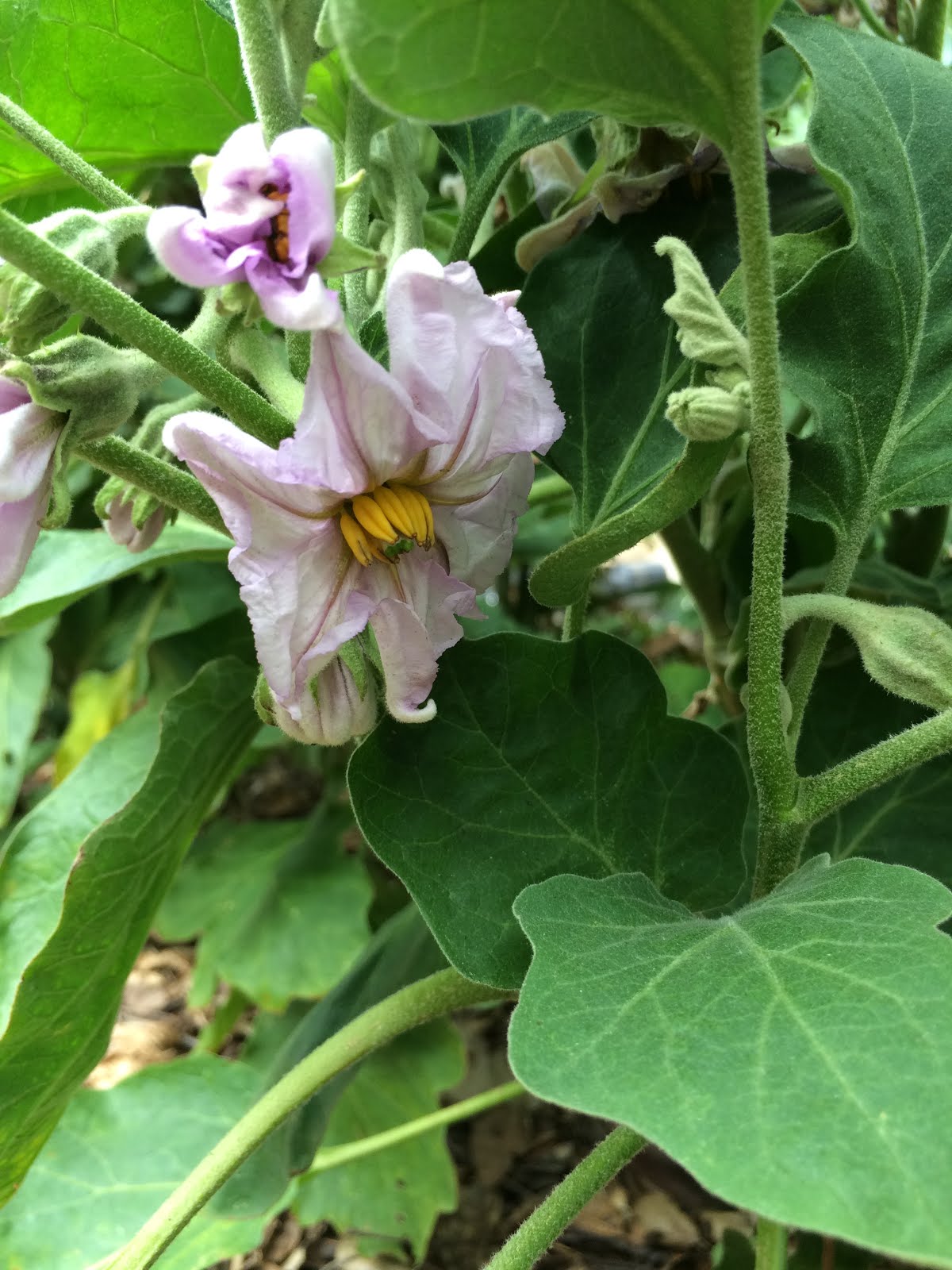
Eggplants are very intense. The flowers are tough little things full of thorns. The eggplants themselves seem indestructible, dark purple, the shiniest thing that ever sprang out of a garden.  When you harvest them, be cautious; those beauties bite back. The stems are full of thorns.

And when they come, boy do they come! And you better know what to do with them. So here is my recipe for Baba Ganoush (or eggplant dish, which is probably what Baba Ganoush means in Arabic).

Don't let the eggplant flower fool you into picking it. It has teeth in back; Very Little Shop of Horrors.

Eggplants are naturally shiny when ripe. As soon as they shine and are deep purple they are ready to harvest no matter the size.
Eggplants are surprisingly pest-resistant and grow late into the fall in Southern California.


BABA Frigging-GANOUSH!
  In France we call this "caviar d'aubergine' Or eggplant caviar. Yum!

1- Put the eegplant in an oven at 350 degrees. Do not pierce the skin or remove the stem. Cook until completely soft, about 45 minutes. Some people wrap them in foil but I don't see what that does beside add aluminum to your blood-stream and the landfill.

2- Let it cool enough to handle without pain.

3- Without burning yourself, the eggplant, or the house, put the eggplant directly on the gas stove without a pan.  Let the flame lick it all over until the skin is died and burned in places.  This is the essential step that will give your Baba Ganoush that complex smoky flavor. No need to carbonize it. A little flame is all it takes.

4- Scrape off all traces of skin or scoop out the flesh.

5- Using a fork crush it all to a puree. I think the blender makes it all too smooth. I like it chunky.

6- Add: juice of 1 lemon (no pits), 2 tablespoons of Tahini, 1 Crushed garlic clove (no skin) and about 1/2 cup olive oil per large eggplant.  Add salt, pepper and a dash of cumin to taste. That's it!

Wednesday, August 3, 2016

Everything You Ever Wanted to Know About Cucumbers but Were Afraid to Ask

For those of you who found this post via google search and are disappointed that this post is, in fact, actually about cucumbers, I invite you to stay anyway. This tedious post about cucurbitacea might be the vegetable equivalent of a cold shower.

**A note of warning to readers who want to know about the cucumber vegetable, this post contains some graphic photos of cucumbers and is filled with cucumber-related language.

Cucumberus Stercus also know as a turd-looking cucumber
Cucumbers are impolite creatures that will grow anywhere if you don't give them something to climb on.

Cucumber can start growing slowly but when they do start they are a little scary.

Here is my husband about to make the rounds to the neighbors' houses to try and give them cucumber. I told him to not think of returning home until the tray is empty.


Oh, no one complained when we offer them tomatoes. Somehow cucumbers are not received with the same level of enthusiasm. So my husband knocks on doors. We see curtains stir but nobody answers.

I'm thinking we could freeze them until Halloween (the cucumbers, not the neighbors) and give to unsuspecting kids. That and a toothbrush.


I tried my hand at pickling cucumbers but that's only kicking the problem down the road: that means months from now I still will have to EAT CUCUMBERS :(((((

The moral of the story:  Do not plant 12 cucumber plants for a family of 4. Plant 2 and even that might even be too much.

Wednesday, July 20, 2016

Looked What "Turnip" in the Garden

Turnips are everything.

They are so pretty with that white and pastel mauve hue.

They are super resistant to disease; they grow in any soil and any weather or season (as long as you live in Los Angeles).

They are great cooked in stews (couscous, boeuf bourguignon) or braised (sauté first and then add a bit of water or broth) or pickled in vinegar (add a slice of raw beet to give the pickled turnip that nice pink color).

Turns out you can juice the greens or cook them (even though they are rough and hurt the hand when picked). Well, not me but I was hoping you'd try and tell me how that went.


Sunday, June 26, 2016

July Harvest in Southern California

Almost overnight, our garden has grown a Ratatouille...


Time to get cooking!

Oh wait. we went on a vacation for a week and look what the harvest table looks like now: